
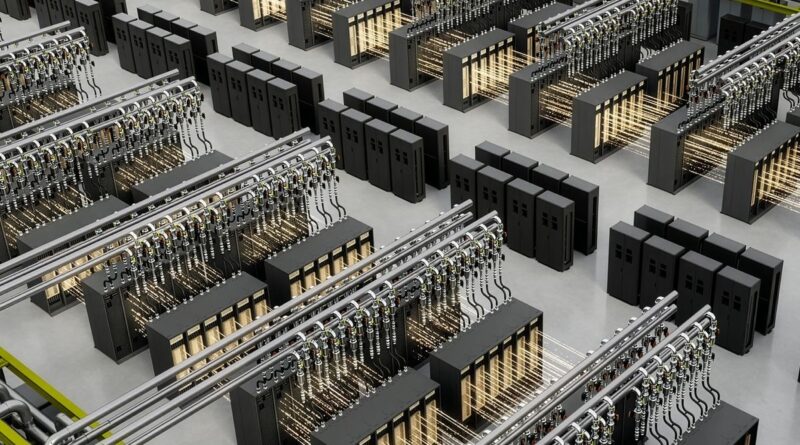
Nvidia’s latest trick for cooling its data center hardware is… hot water? ‘Hot liquid cooling’ is warmer than a hot tub, but apparently does the job pretty well
Nvidia’s Revolutionary Liquid Cooling: A Game-Changer for Data Centers
Nvidia’s latest innovation in AI server technology is making waves with its unique approach to liquid cooling. This cutting-edge development not only enhances performance but also significantly reduces environmental impact—a crucial consideration in today’s climate-conscious world.
The Heat Behind Nvidia’s Cooling System
Nvidia’s Rubin-generation AI servers utilize a liquid cooling system that operates at temperatures hotter than a typical hot tub, entering at 45°C and exiting at 55°C. Despite the high temperatures, there’s no performance loss, thanks to the efficient heat transfer between the server chips and the coolant.
Why This Matters
- Efficiency: By maintaining a temperature gradient, Nvidia ensures optimal heat transfer, allowing servers to run at peak performance without overheating.
- Environmental Impact: This approach conserves approximately 2.6 million gallons of water per megawatt annually, translating to significant cost savings—up to $4 million for a 50MW site.
Breaking Down the Technology
Nvidia’s design is 100% liquid-cooled, integrating this system at a platform level across all chips and networking components. The closed-loop system minimizes water usage, relying on a 3:1 water-to-propylene-glycol mix to efficiently dissipate heat.
Key Features
- Closed-Loop System: Reduces water consumption to nearly zero by eliminating evaporative cooling.
- Energy Savings: Industrial chiller plants benefit from a 4% energy cost reduction per degree of increased operating temperature.
Industry Impact: A Sustainable Future
Nvidia’s liquid cooling design isn’t just about immediate savings. It sets a precedent for future data centers, particularly in drought-prone areas where water conservation is crucial. The company’s DSX reference design outlines best practices for constructing AI factories with minimal environmental footprints.
Key Takeaways
- Scalability: Nvidia expands on earlier innovations by scaling liquid cooling across entire facilities rather than individual machines.
- Sustainability: The design aligns with global efforts to reduce carbon footprints and resource consumption.
- Economic Benefits: Reduced cooling costs and water usage offer substantial financial incentives for data centers to adopt this technology.
The Bigger Picture
While Nvidia’s solution addresses the pressing issue of power density in AI accelerators, it also highlights a broader trend towards sustainable computing. The shift from traditional air cooling to hot-water systems demonstrates a pragmatic approach to energy efficiency in high-performance computing environments.
Nvidia’s innovation not only tackles the technical challenges of cooling but also paves the way for a more sustainable and cost-effective future in AI and data center operations.


